
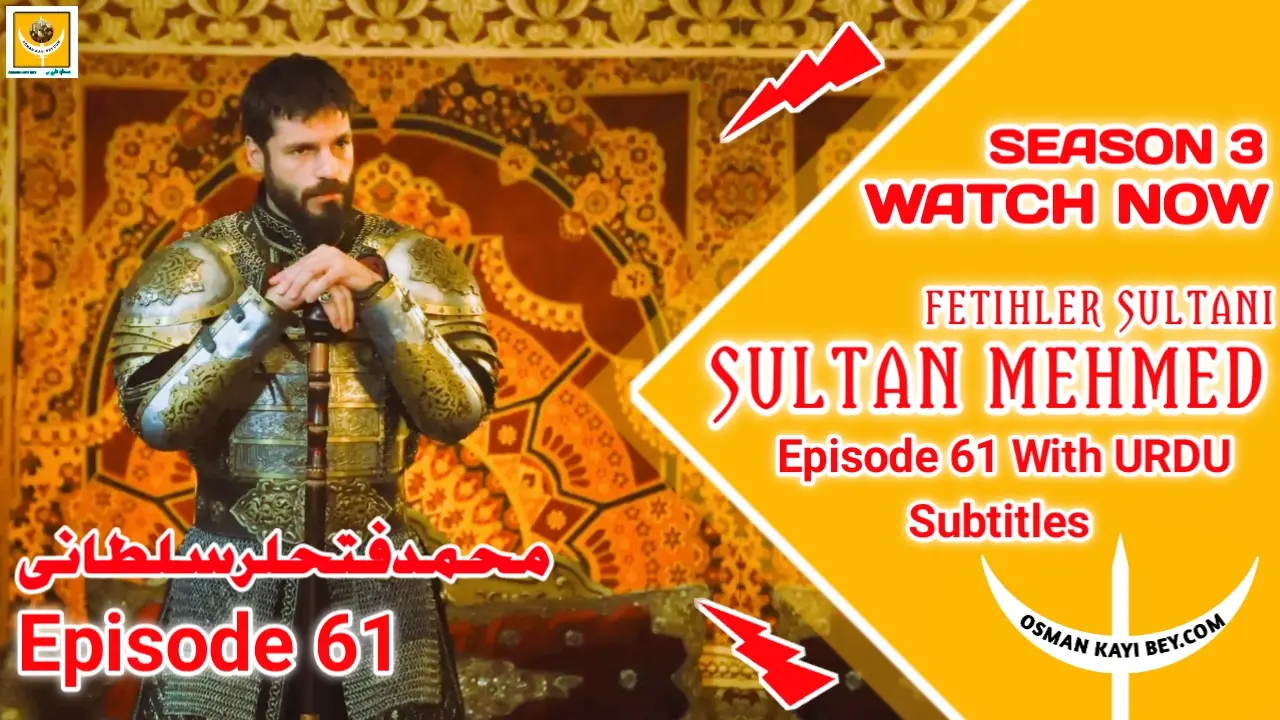
Mehmed Fetihler Sultani Season 3 Episode 61 Urdu Subtitles
The siege of Pontus reaches its most dangerous turning point in Episode 61, where the battlefield, the palace, and the inner world of the characters collide to create a chain of events that reshape the direction of Mehmed’s campaign. The episode does not rely solely on the spectacle of war; instead, it uncovers the social fractures, personal ambitions, political cracks, and the psychological conflicts simmering beneath the surface of both armies.
Mehmed Fetihler Sultani Season 3 Episode 61 Urdu Subtitles
From the moment the Akincis slip through the damaged section of Pontus’ walls, the tone of the narrative changes drastically. Their entry, once seen as a tactical victory, becomes a revelation of the hidden dangers that await inside. The corridors echo with eerie silence, torchlight flickers on stone walls, and the Akincis soon realize that they are navigating not through ruins—but through a trap meticulously designed by Draven. The trap’s intention is not just to kill them, but to demoralize Mehmed’s forces by showing that Pontus still holds deadly secrets.
The Unseen Fault Lines Inside Mehmed’s Ranks
When word reaches Mehmed that the breach did not unfold as expected, his mind immediately leaps beyond the battlefield. The Sultan’s strength has always been his ability to analyze not just what happened but why it happened. He recognizes that the collapse is not the failure of a unit—it is a sign of betrayal. A single misstep does not worry him; a pattern of misdirection does.
The information brought by Akıncı Mustafa becomes another flashing signal. His report, filled with small inconsistencies and unusual movements inside Pontus, helps Mehmed connect dots that others might overlook. This sharp instinct drives him to reconsider every piece of intelligence they have received recently. The tension in Mehmed’s expressions suggests that he has already begun to form a silent list of suspects.
And at the top of that list stands Vlad Tepes.
The episode beautifully portrays the mental struggle inside Vlad. His pauses, the distant emptiness in his eyes, and the haunting repetition of “Vlaciu” around him paint the portrait of a man who is slowly drifting away from reason. Even Bayezid senses something unsettling, proving that Vlad’s transformation is no longer hidden—it is becoming a living threat.
The Secret Bargain of Yorgo: Diplomacy in the Dark
One of the most unique elements of the episode is the clandestine meeting between Yorgo, the Megaduke of Pontus, and Mehmed. Unlike previous episodes where diplomacy is presented in council halls or royal chambers, this moment is quiet, tense, and fueled by desperation. Yorgo’s face reveals a man caught between two collapsing worlds—the empire he serves and the moral responsibility he carries toward the innocent people trapped inside Pontus.
Yorgo’s promise to open the gates within a day and deliver the Emperor is not simply a strategic offer. It is an act of rebellion against the violent tactics of men like Draven. He knows that if he fails, he will be remembered as a traitor by his own people. If he succeeds, he becomes a man who saved thousands from pointless death.
But fate offers no mercy.
Draven senses the shift in Yorgo’s behavior. The silent pursuit that follows becomes a haunting metaphor for how betrayal hunts both sides in a war. When Draven strikes, the blow is swift and merciless. Yorgo’s attempt to escape becomes a struggle for breath, for time, for one last chance to fulfill his promise.
When the moment arrives and Mehmed’s men watch the Pontus gates from afar, the silence they receive becomes an answer in itself. The unanswered promise becomes the final fracture between diplomacy and inevitability.
Shahi Cannons and the Rewriting of Fate
With no sign from Yorgo, Mehmed takes command of destiny with a decision that echoes through history. He orders the Shahi cannons to strike the Notia walls—a move that symbolizes more than military force. It reflects Mehmed’s belief that fate favors those who refuse to wait for miracles.
The thunder of the cannons becomes its own narrative thread. The stones crack under colossal pressure, dust swirls through the air, and the sound trembles through the entire fortress. It is not merely destruction; it is the collapse of Pontus’ confidence.
Through the gaping wound in the wall, the Janissaries surge forward like a rising tide. The miners follow with precision, and the Akincis, despite previous setbacks, charge with renewed fury. Every street becomes a battlefield where the final resistance of Pontus takes shape. Flames rise, steel clashes, and screams echo across rooftops, reflecting a city fighting against time rather than against Mehmed.
Eren’s Transformation: From Soldier to Symbol
Among the chaos, the most breathtaking transformation unfolds through Eren. His journey from a wounded soldier to a living symbol of Ottoman resolve becomes the soul of Episode 61. The injuries he carries reflect more than physical pain—they represent the emotional weight of sacrifice, the legacy of warriors before him, and the dreams of those who never returned home.
His earlier visions of Ulubatli Hasan, once seen as spiritual guidance, now become a promise he must fulfill. Climbing the battlements under a sky filled with arrows, his movements resemble a man fighting against destiny itself. When he raises the three-crescent banner, the flag’s fabric ripples like the final breath of Pontus’ resistance.
In that moment, the city falls silent—not because the battle has ended, but because a new chapter has begun.
The Birth of a New Darkness: Vlad’s Declaration
While the city collapses, Vlad Tepes is swallowed by shadows. His final whisper is not a threat—it is a prophecy:
“If Mehmed cannot kill the Fatih within himself… then I will do it for him.”
This line introduces the darkest angle of the episode. Vlad no longer seeks victory through armies or politics. He wants to destroy Mehmed’s identity—the “Fatih,” the conqueror spirit that defines him. This marks Vlad not just as a villain, but as a psychological adversary determined to corrupt history itself.
I dedicate my time and effort to sharing Islamic history and the legacy of our heroes with the world. Your small donation helps me continue this mission. May Allah reward your support. 🤲
💖 Don’t be shy, even $3 makes a difference and helps keep this work going! ❤️
Mehmed Fetihler Sultani Season 3 Episode 61 With Urdu Subtitles
SOURCE 1
Character Analysis
Mehmed
Focused, introspective, and increasingly aware of the blurred line between loyalty and treachery. His leadership shifts into a sharper, more instinct-driven form.
SOURCE 2
Vlad Tepes
His descent into darkness becomes clearer. His motivations begin to merge with madness, forming a threat far more dangerous than any army.
SOURCE 3
I dedicate my time and effort to sharing Islamic history and the legacy of our heroes with the world. Your small donation helps me continue this mission. May Allah reward your support. 🤲
💖 Don’t be shy, even $3 makes a difference and helps keep this work going! ❤️
Draven
A relentless force of violence and order. His loyalty to Pontus is overshadowed by his desire for control.
Yorgo
A tragic figure whose hope for peace becomes crushed by the brutal world he is trapped in.
Eren
The emotional anchor of the episode. His courage transforms a military victory into a symbolic triumph.
Themes and Symbolism
The Fragility of Trust
Every alliance breaks apart under pressure, showing that trust is the rarest weapon in war.
Destiny Versus Willpower
Mehmed chooses action over uncertainty, proving that destiny bends toward those who shape it.
Legacy and Memory
Eren’s flag-raising moment is a tribute to warriors like Ulubatli Hasan, connecting past triumphs with present struggles.
Darkness Within
Vlad symbolizes the psychological warfare that threatens Mehmed’s identity more than the enemy’s swords.
Comparative Table: Strategic vs. Symbolic Elements in Episode 61
| Element | Strategic Purpose | Symbolic Meaning |
|---|---|---|
| Akincis entering Pontus | Attempted tactical breach | The cost of blind trust |
| Shahi cannons | Forced breakthrough | Mehmed reshaping destiny |
| Eren’s flag | Marking victory | Legacy of Ottoman heroes |
| Yorgo’s deal | Diplomatic short-cut | Collapse of peace attempts |
| Vlad’s whisper | Foreshadowing betrayal | Battle for Mehmed’s soul |
Key Takeaways
- Episode 61 presents war not only as physical conflict but as psychological and moral struggle.
- Mehmed’s intuition becomes the strongest weapon on the battlefield.
- Eren’s bravery gives the conquest its emotional depth.
- Vlad emerges as a future threat shaped by madness rather than politics.
- Pontus’ fall sets the foundation for darker, more intense upcoming episodes.
FAQ
What makes Episode 61 unique?
Its combination of psychological tension, battlefield strategy, and symbolic storytelling.
Why does Mehmed lose trust?
Intelligence from inside Pontus reveals internal sabotage rather than military error.
What does Eren’s moment symbolize?
Hope, victory, and the eternal legacy of Ottoman warriors.
What does Vlad intend by his final whisper?
He plans to destroy Mehmed’s inner identity—the “Fatih” spirit within him.
Conclusion
Episode 61 delivers a powerful combination of emotional storytelling, symbolic imagery, and strategic brilliance. The fall of Pontus becomes more than a victory—it becomes a transformation for every character involved. Mehmed grows sharper, Eren becomes iconic, Yorgo turns tragic, and Vlad becomes the shadow looming over future events. The episode ensures that the struggles ahead will be darker, more psychological, and far more personal.
- Mehmed Fetihler Sultani Season 3 Episode 58 with English Subtitles
- Kurulus Orhan Season 1 Episode 3 With Urdu Subtitles
- Mehmed Fetihler Sultani Season 3 Episode 60 With English Subtitles
- Mehmed Fetihler Sultani Season 3 Episode 60 With Urdu Subtitles
- Mehmed Fetihler Sultani Season 3 Episode 58 With Urdu Subtitles