
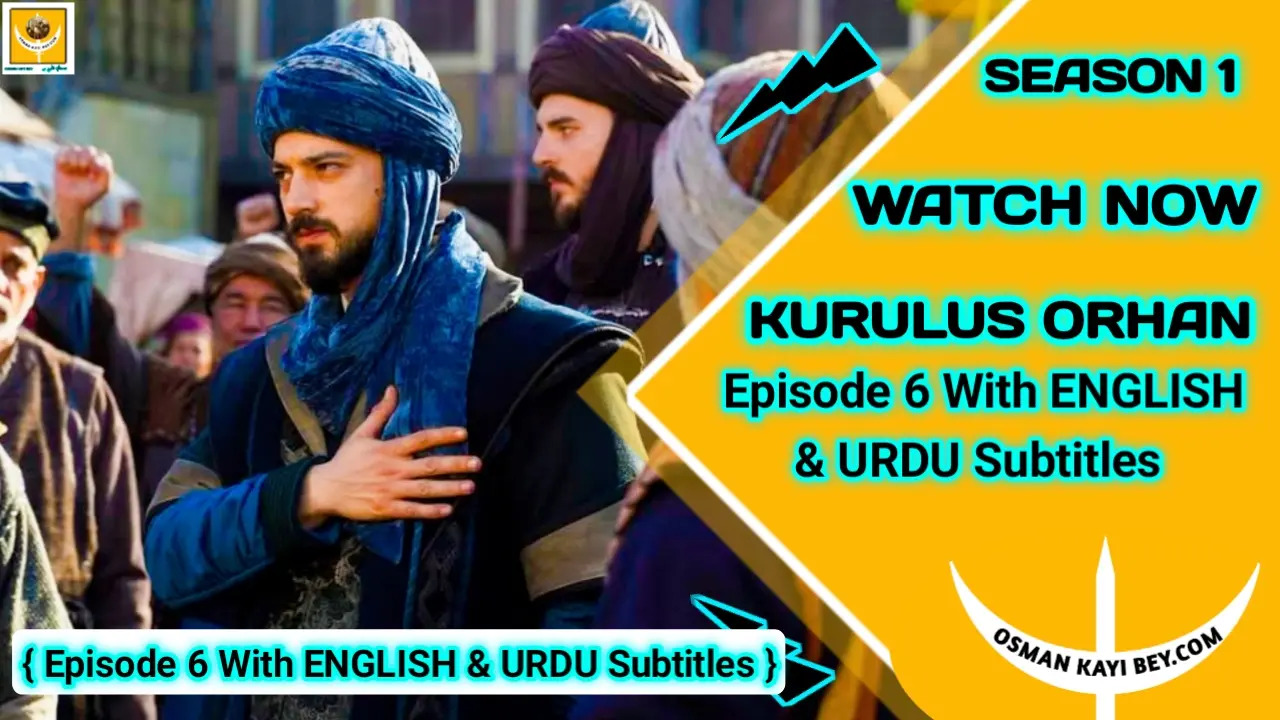
Kurulus Orhan Season 1 Episode 6
The Expanding Shadow Over Bursa
Kurulus Orhan Season 1 Episode 6 unfolds at a moment when the frontier world is shaking under political shifts, emotional conflicts, and unseen threats. Although the episode appears to revolve around Orhan Bey’s strategic generosity toward the people of Bursa, a deeper look reveals a much more complex landscape—one shaped by ideological battles, changing loyalties, and the birth of a mindset that would eventually define the Ottoman future. In this retelling, the movements of the characters are not only part of a struggle for territory but also reflections of wider historical tensions between Christian Byzantine authority and rising Turkmen political identity. As Orhan’s decisions echo across the lands, Episode 6 becomes a powerful combination of strategy, symbolism, and social transformation.
Kurulus Orhan Season 1 Episode 6
At the heart of Bursa’s fate lies not just the clash of warriors but the struggle for the hearts of its people. The episode suggests that Orhan Bey understands something many rulers of the time never learned: cities are not taken only by swords—they are won by compassion. The people inside Bursa, tired of war and starvation, become silent participants in Orhan’s campaign. Meanwhile, the Byzantine leadership fears not his armies but the possibility of losing their subjects to the moral authority of the Turks. Thus, this episode turns military history into moral history.
Orhan Bey’s Benevolence as a Form of Warfare
What makes Episode 6 particularly rich is how the writers portray Orhan Bey’s unusual strategy: using catapults not to destroy a city, but to feed it. This moment, while symbolic and dramatic, reflects the historical reality that many Turkish beys sought legitimacy through justice and mercy. Rather than depicting a typical siege scene filled with fire, they show something far more powerful—food raining over the walls of Bursa.
This extraordinary gesture forces viewers to rethink early Ottoman expansion. It was not simply a story of battlefield victories; it was a story of public sentiment. Orhan Bey’s decision is not a random act of kindness. It is a calculated move designed to create an emotional bridge between conqueror and conquered, one that challenges the Byzantine belief that Turks were merely destructive outsiders. In this unique approach, the people of Bursa become aware of Orhan as someone who sees their suffering and acts upon it.
This shift marks the beginning of psychological warfare, where compassion becomes a weapon stronger than any blade. Moreover, this move shakes the Byzantine worldview and triggers discussions within imperial circles—how could a young bey turn mercy into an act of dominance?
I dedicate my time and effort to sharing Islamic history and the legacy of our heroes with the world. Your small donation helps me continue this mission. May Allah reward your support. 🤲
💖 Don’t be shy, even $3 makes a difference and helps keep this work going! ❤️
The Byzantine Reaction: Fear Wrapped in Politics
Episode 6 highlights how empires perceive kindness not as virtue but as danger. The Byzantine Emperor, upon learning of Orhan’s benevolent act, interprets it as an attempt to infiltrate and provoke rebellion. This angle creates an intense contrast between the moral actions of the frontier and the paranoid politics of Constantinople.
Kurulus Orhan Season 1 Episode 6 With English And Urdu Subtitles
I dedicate my time and effort to sharing Islamic history and the legacy of our heroes with the world. Your small donation helps me continue this mission. May Allah reward your support. 🤲
💖 Don’t be shy, even $3 makes a difference and helps keep this work going! ❤️
The Emperor’s meeting with Flavius and the Tekfur of Iznik is not simply a war council—it is a moment of imperial anxiety. The Emperor, haunted by the declining influence of Byzantium and the growing power of the Turkish principalities, fears the rise of a charismatic enemy more than an army. His fear becomes a commentary on the political fragility of late Byzantium, where distrust overshadows reason.
This council scene opens several historical angles rarely shown in dramas:
- Byzantine rulers often feared internal uprisings more than external invasions.
- Economic decline made urban populations volatile and easily swayed.
- Compassionate rulers on enemy borders created ideological threats.
Thus, Orhan’s gesture becomes a catalyst that intensifies imperial restlessness. Episode 6 subtly mirrors real history, showing that reforms, generosity, or social welfare often frightened medieval powers more than violence ever could.
Söğüt and the Rise of an Invisible Enemy
While Bursa trembles under political tension, Söğüt faces a very different kind of threat—one wrapped in symbols rather than flags. This mysterious enemy introduces a new narrative layer: not all forces in this world fight for a state, a tribe, or an empire. Some fight for ideas hidden from ordinary eyes.
The symbol-bearing group represents a shadowy network that moves through the cracks of Anatolia, using secrecy as its strength. Their presence in Söğüt serves as a reminder that frontier society was not only shaped by open battles but also by covert operations, secret alliances, and ideological foundations. They operate outside the typical power structure, creating a web that neither Orhan Bey nor the Byzantines can easily comprehend.
Their emergence forces Orhan to expand his understanding of leadership. He must now navigate not only enemy armies but also the invisible forces that manipulate events from the background. These hidden antagonists contribute a deeper, almost philosophical dimension to the episode, suggesting that the struggle for Anatolia was not merely territorial—it was also intellectual and spiritual.
Flavius and Fatma: A Dangerous Proximity
One of the most compelling new angles emerges from the unexpected closeness between Flavius and Fatma. Episode 6 enriches this interaction by transforming it into a psychological battlefield. Fatma’s innocence stands in stark contrast to Flavius’s concealed identity. As he grows more entangled in the persona of a traveling merchant, the layers of deception become more emotionally intense.
Their conversation is not merely a brief encounter—it becomes a reflection of cultural encounters in medieval Anatolia. Two individuals from opposing worlds stand face to face, yet neither fully understands the other’s true intentions. Flavius’s plan to deepen his disguise introduces suspense, but at a deeper level, it reveals how deceptive charm can become a weapon more powerful than a sword.
Fatma, unaware of the trap slowly forming around her, becomes a symbolic representation of the vulnerabilities within the tribe—trust, hospitality, and openness. These virtues are admirable but, in the hands of an enemy, they become points of exploitation. Thus, their storyline becomes a lesson on how even the warmest cultural traditions can be manipulated when facing hidden threats.
Internal Frictions: Marriages, Alliances, and Emotional Storms
Episode 6 introduces social tensions within the tribe as marriage proposals for Fatma and Halime begin to circulate. While this may seem like a lighter subplot, the political implications run deeper. Marriage in tribal societies was never merely personal—it was strategic. Families formed alliances, strengthened unity, or resolved long-standing disputes through such unions.
Didar Hatun’s involvement adds a layer of ambition and subtle power play, transforming the marriage arrangement into a negotiation of influence. Her attempt to match Fatma with Yigit is not just about affection; it is about shaping the political complexion of the tribe.
Malhun and Nilufer’s coldness toward one another creates emotional storms that mirror the broader turmoil around them. Even these interpersonal shifts reflect the real concerns of frontier life, where internal cohesion was essential for survival. Any break in unity, no matter how small, could become a crack that enemies might exploit.
Temurtas and the Question of Loyalty
Orhan Bey’s decision to restrain Temurtas reveals another dimension of leadership—understanding the unpredictable nature of tribal loyalty. By assigning the task to Alaeddin and Sahinsah, Orhan shows increasing maturity in delegating responsibilities. Yet this situation brings forward a new question: is Sahinsah truly loyal?
Episode 6 introduces subtle hints regarding Sahinsah’s ambitions and possible secret motives. His actions are cloaked in ambiguity, leaving viewers unsure whether he is driven by honor or hidden resentment. This uncertainty adds psychological depth to the narrative, reminding us that treachery often arises not from enemies but from within.
Temurtas’s potential betrayal symbolizes the harsh reality of medieval alliances: loyalty was often conditional, fragile, and vulnerable to personal gain.
The Arrival of the Emperor and the Enigmatic Woman
The most striking moment of Episode 6 comes with the Emperor’s sudden arrival in the Kayi camp—a dramatic symbol of the shifting tides in Anatolia. The presence of the woman who accompanies him introduces a mysterious force capable of altering tribal politics.
Her identity, intentions, and connection to imperial strategies open new narrative doors. She represents the elegance, secrecy, and danger of Byzantine diplomacy. Her arrival unsettles the tribe, not through violence, but through the uncertainty she brings. She embodies the fear that sometimes the most dangerous enemy is not one who attacks with swords but one who enters with silence.
Her influence foreshadows future political upheavals, emotional complications, and alliances that may reshape Orhan’s path.
Table: Key Themes Highlighted in Episode 6
| Theme | Significance | Impact on Story |
|---|---|---|
| Compassion as strategy | Orhan’s food delivery to Bursa | Shakes Byzantine confidence |
| Shadow enemies | Symbol-based mysterious group | Expands conflict beyond battlefield |
| Emotional diplomacy | Flavius–Fatma tension | New vulnerability in tribe |
| Internal alliances | Marriage proposals | Social tension rising |
| Imperial anxiety | Emperor’s fear of rebellion | Political tension escalates |
Quote Highlight
“A city conquered by fear is lost again. A city won by hearts remains forever.”
This quote captures the philosophical heart of Episode 6.
Key Takeaways
- Orhan Bey uses empathy as a powerful strategic tool.
- Byzantine leadership fears internal rebellion more than war.
- Söğüt faces an unseen, highly symbolic enemy.
- Personal relationships become potential political vulnerabilities.
- The Emperor’s arrival signals an escalation of ideological conflict.
FAQ
Q1: Why does Orhan send food into Bursa instead of attacking?
Because he aims to win the people, not destroy them, reflecting a long-term strategy inspired by early Ottoman moral politics.
Q2: Who are the symbol-bearing enemies in Söğüt?
They represent a covert force working outside known alliances, introducing psychological and ideological threats.
Q3: Why is the Emperor so disturbed by Orhan’s actions?
He fears losing the loyalty of Bursa’s citizens, which would weaken Byzantine authority without a direct battle.
Q4: What role does the mysterious woman play?
She symbolizes Byzantine diplomatic influence and hints at future complications within the tribal world.
Conclusion
Kurulus Orhan Season 1 Episode 6 delivers a remarkable blend of political intrigue, emotional depth, cultural richness, and strategic brilliance. Orhan Bey’s approach to leadership demonstrates wisdom far beyond his years, turning compassion into a tactical advantage. The Byzantines react with fear, revealing the weakening heart of their empire. Meanwhile, hidden enemies and internal conflicts hint at storms approaching Söğüt. With the Emperor’s unexpected arrival and a mysterious woman at his side, the frontier world stands on the edge of transformation.