
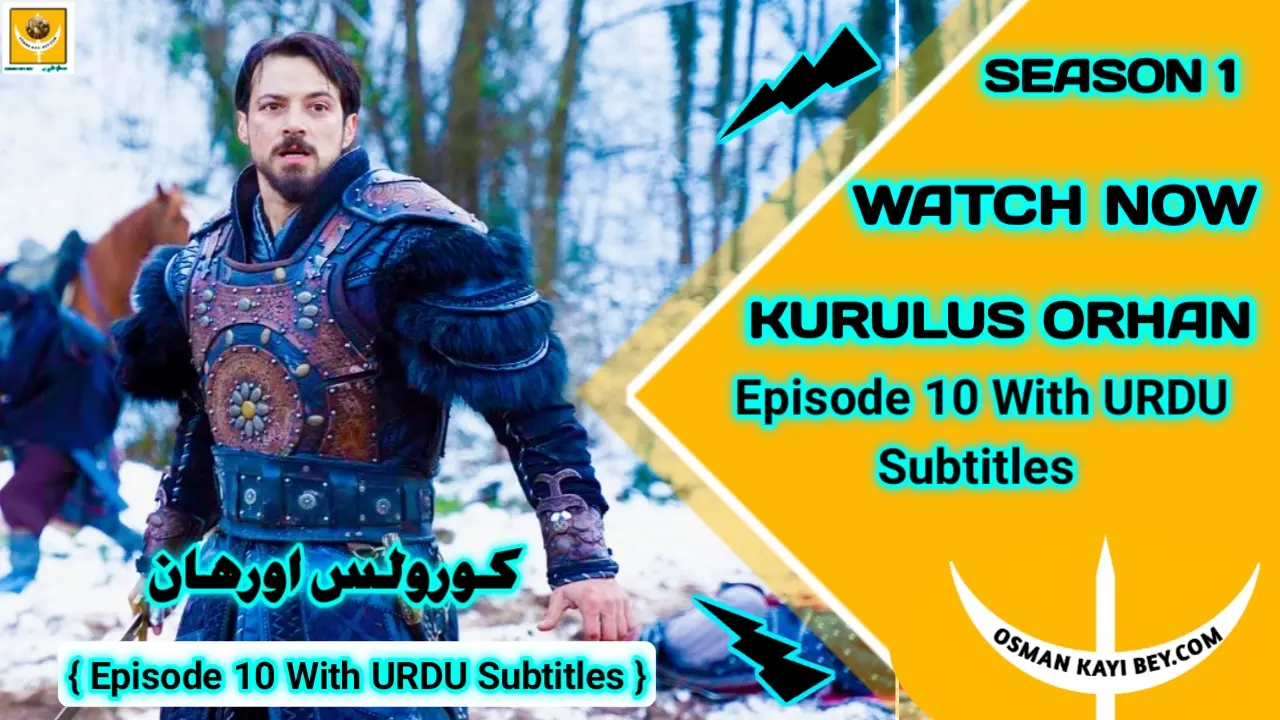
Kurulus Orhan Season 1 Episode 10 With Urdu Subtitles
The Making of Power Before the Fall of Cities
Episode 10 of Kurulus Orhan does not rush toward spectacle. Instead, it slows the rhythm deliberately, allowing the audience to witness something far more dangerous than open war: the birth of calculated authority. This episode is not concerned with who strikes first, but with who forces the other to strike blindly. Orhan Bey has crossed a threshold. He is no longer a leader shaped by circumstances; he is becoming a leader who shapes circumstances themselves.
After the events of Episode 9, the political landscape surrounding the Kayi oba has entered a fragile equilibrium. No swords are raised, yet every silence carries threat. No declarations are made, yet every decision reshapes the future. Episode 10 exists entirely within this tension.
Orhan Bey’s Evolution: From Reaction to Design
What defines Orhan Bey in this episode is restraint. He does not celebrate surviving Hector’s trap. He does not display Princess Asporca as a trophy. Instead, he allows uncertainty to do the work violence cannot. His leadership matures visibly, shifting from battlefield courage to strategic foresight.
Orhan Bey understands that Hector’s greatest weakness is not military inferiority, but predictability. Hector expects retaliation. He expects aggression. Orhan Bey offers neither. By keeping Asporca inside the oba under dignified conditions, Orhan Bey destabilizes the Byzantine command structure without sending a single soldier forward.
This is the episode where Orhan Bey begins to think like a ruler rather than a warrior. His conversations are shorter, his expressions heavier, his silences intentional. He observes how information travels, how fear multiplies when clarity is denied, and how enemies begin to fracture when they cannot define the threat facing them.
True power does not announce itself. It waits until resistance becomes meaningless.
Princess Asporca: Pride Confronted by a New Order
Asporca’s role in Episode 10 deepens beyond that of a captured noblewoman. She is not imprisoned, yet she is not free. This ambiguity torments her far more than chains ever could. Raised in an imperial culture where dominance is overt and submission is enforced, Asporca struggles to comprehend a system where authority does not need cruelty to function.
Her presence within the Kayi oba becomes a mirror through which two civilizations observe each other. She watches decisions being made collectively, disputes settled without humiliation, and leadership exercised without intimidation. These observations quietly unsettle her sense of superiority.
Her tension with Nilüfer Hatun reflects more than personal conflict. It is a confrontation between entitlement and legitimacy. Asporca begins to realize that Orhan Bey does not need her loyalty or fear. He needs her exactly where she is — conscious, resistant, and visible — because her very existence inside the oba weakens Byzantine certainty.
Nilüfer Hatun: Authority Rooted in Balance
Nilüfer Hatun’s influence in Episode 10 is subtle yet profound. She does not challenge Asporca openly, nor does she seek dominance. Her strength lies in maintaining equilibrium within the oba at a time when disruption could easily turn inward.
Nilüfer understands Orhan Bey’s strategy intuitively. She ensures Asporca is neither humiliated nor empowered, maintaining a balance that prevents internal unrest. Her leadership emerges not through command, but through emotional intelligence. She listens where others argue, and she observes where others react.
This episode positions Nilüfer Hatun as more than a supporting figure. She becomes a stabilizing force essential to Orhan Bey’s broader vision, hinting at her future role in governance rather than mere companionship.
Hector’s Crisis: Authority Without Direction
On the Byzantine front, Episode 10 exposes Hector’s unraveling authority. Unable to explain Asporca’s survival within enemy territory, he resorts to fear-based control. His decisions grow impulsive, his commands increasingly detached from strategy.
Hector’s greatest mistake is internal. By demanding proof of loyalty through bloodshed, he undermines the very structure he seeks to protect. Leaders who rule through fear inevitably isolate themselves, and Episode 10 marks the beginning of Hector’s isolation.
He no longer shapes events; he reacts to them. And reaction, in politics, is the first step toward collapse.
Flavius and Fatma Hatun: Humanity as Rebellion
Flavius’s internal struggle becomes one of the most emotionally charged elements of the episode. Ordered to kill in the name of loyalty, he is forced to confront the cost of obedience. Fatma Hatun represents a life untouched by institutional brutality — a life of conscience, memory, and choice.
What makes this conflict powerful is its silence. Flavius does not voice his hesitation, yet it dominates every scene he occupies. The episode frames love not as weakness, but as resistance against dehumanization. In a system that demands absolute submission, the mere act of hesitation becomes revolutionary.
Episode 10 makes it clear: if Flavius chooses mercy, he will lose his place among the Knights. If he chooses obedience, he will lose himself.
Osman Bey’s Dream and Orhan Bey’s Preparation
While Osman Bey’s dream of Bursa looms in the background, Episode 10 grounds that vision in reality. Orhan Bey begins laying the foundation for conquest not through force, but through preparation. Scouts observe supply routes rather than fortifications. Alliances are studied, not attacked.
This episode emphasizes a crucial truth: cities fall long before walls break. Economic pressure, political isolation, and internal distrust weaken defenses more effectively than armies. Orhan Bey understands that when Bursa finally faces confrontation, it will already be defeated.
Halime and Dursun: Growth Through Displacement
Away from the political center, Halime and Dursun’s exile provides a quiet counterpoint. Stripped of security, their conversations become honest and unguarded. Love here is not dramatic or heroic; it is uncertain, hesitant, and human.
Their journey suggests that separation from power can become a form of education. Through hardship, they gain clarity — a theme that mirrors Orhan Bey’s own evolution through restraint rather than conquest.
Shifting Power Dynamics
| Character | Visible Position | Inner Conflict | Direction |
|---|---|---|---|
| Orhan Bey | Strategic Leader | Timing vs Action | State builder |
| Asporca | Political Captive | Pride vs Reality | Transformation |
| Hector | Byzantine Commander | Fear of losing control | Strategic decline |
| Flavius | Knight | Love vs Obedience | Moral rupture |
| Nilüfer Hatun | Stabilizer | Balance vs Authority | Emerging governance |
Themes and Symbolism
Episode 10 explores silence as power, patience as dominance, and humanity as rebellion. The absence of immediate violence creates deeper tension, reinforcing the idea that true authority does not rely on constant force.
Asporca symbolizes Byzantium’s presence within Turkish destiny — observed, understood, and gradually neutralized. Flavius symbolizes the cost of rigid loyalty. Orhan Bey symbolizes the transition from tribal leadership to statecraft.
Looking Ahead
Every thread introduced in Episode 10 points toward inevitable transformation. Hector’s fear-driven decisions foreshadow betrayal. Flavius’s hesitation suggests defection or tragedy. Nilüfer’s growing influence hints at future governance. Orhan Bey’s preparations mark the silent beginning of Bursa’s fall.
This episode does not seek to impress through action.
It seeks to prepare history.
And in doing so, it succeeds.
I dedicate my time and effort to sharing Islamic history and the legacy of our heroes with the world. Your small donation helps me continue this mission. May Allah reward your support. 🤲
💖 Don’t be shy, even $3 makes a difference and helps keep this work going! ❤️
Join Our Official WhatsApp & Telegram Channel
Kurulus Orhan Season 1 Episode 10 With Urdu Subtitles
SOURCE 1
What Episode 10 Sets in Motion
SOURCE 2
Everything introduced here is foundational. Hector’s loss of control will invite betrayal. Asporca’s exposure to a new system will force her to choose between identity and truth. Nilüfer Hatun’s quiet authority will expand beyond the oba. Flavius’s hesitation will demand resolution.
SOURCE 3
Most importantly, Orhan Bey’s patience will soon require action — not because he is forced to act, but because the conditions he created will finally demand it.
I dedicate my time and effort to sharing Islamic history and the legacy of our heroes with the world. Your small donation helps me continue this mission. May Allah reward your support. 🤲
💖 Don’t be shy, even $3 makes a difference and helps keep this work going! ❤️
Key Takeaways from Episode 10
Episode 10 proves that power rooted in fear decays, while power rooted in understanding expands. It shows that leadership evolves when violence becomes the last option rather than the first. And it confirms that the road to Bursa is not paved with bodies, but with decisions made long before armies move.
Frequently Asked Questions
Yes, deliberately so. Its focus is strategic and psychological rather than action-driven.
Absolutely. It prepares the ground more effectively than any battle could.
The episode strongly suggests that his loyalty is nearing a breaking point.
Because her dignity is being used as a political weapon rather than destroyed.