
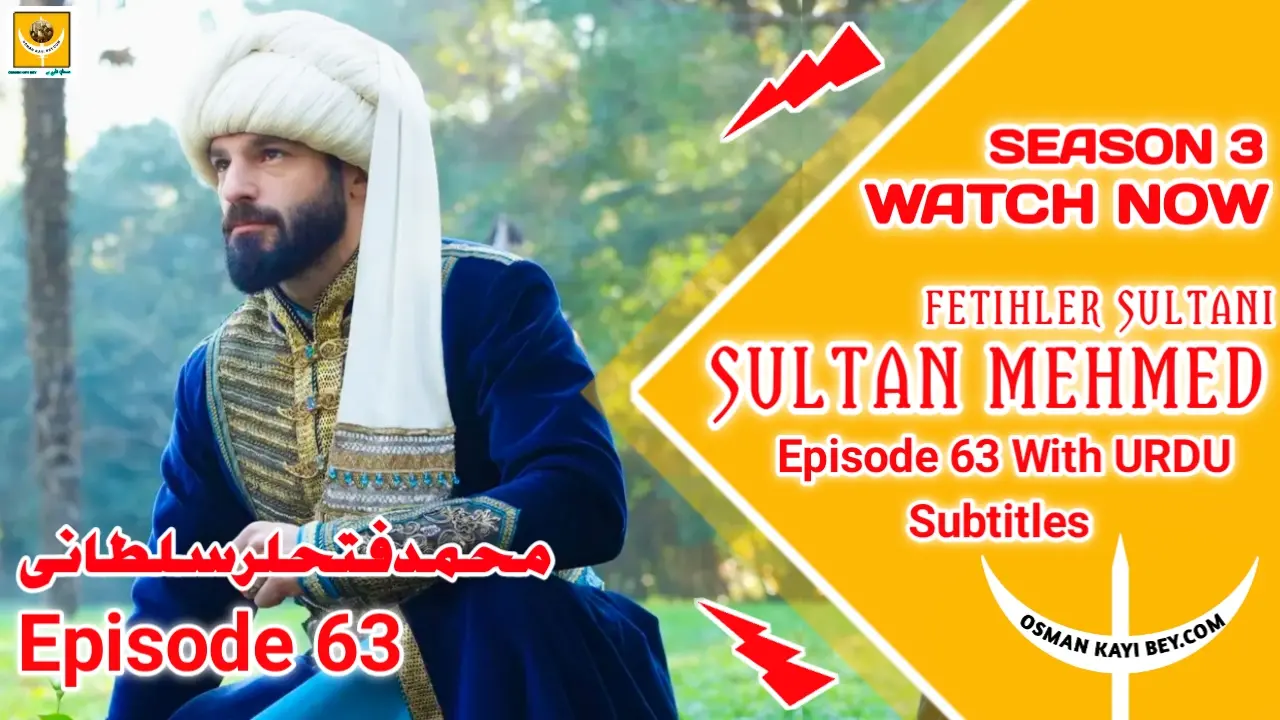
Mehmed Fetihler Sultani Season 3 Episode 63 With Urdu Subtitles
After the Siege: Stability or Chaos?
Episode 63 picks up immediately after the Ottoman army’s critical victory in the previous siege. The city has fallen, but the walls are only the beginning. Sultan Mehmed now faces a challenge far more complex than combat: consolidating power, ensuring loyalty, and managing hidden threats. While victory appears complete, Episode 63 emphasizes that true conquest is measured by governance, influence, and the ability to navigate unseen political currents.
The streets are quiet yet tense, civilians and soldiers alike cautiously adjusting to the new order. In this uneasy calm, Mehmed must act decisively, not with brute force, but with strategy, intelligence, and foresight. The episode immediately highlights the Ottoman principle that a ruler’s presence, insight, and moral authority are as critical as armies in achieving lasting stability.
Sultan Mehmed’s Strategic Moves
Sultan Mehmed begins Episode 63 by securing key districts and infrastructure within the city. He understands that fragmented control can ignite rebellion, and that apparent victory can quickly turn to chaos without proper administration. He assigns trusted beys to manage different city sectors while personally overseeing the central command, ensuring no single faction gains undue influence.
Mehmed’s decisions reflect a dual focus: maintaining security and observing human behavior. By walking the streets himself and inspecting the city, he gauges loyalty, fear, and potential discontent. This hands-on approach allows him to identify which commanders and local elites can be trusted to maintain order and which require monitoring or re-alignment.
“A city conquered without insight is a kingdom that can crumble from within.”
This philosophy underscores Mehmed’s broader vision: victory is not the fall of walls, but the stability of the empire.
Beys, Commanders, and the Politics of Loyalty
Episode 63 delves deeper into the psychology of Mehmed’s closest allies. The beys and paşas are not merely soldiers—they are political actors, each with ambitions, loyalties, and hidden agendas. Some seek to capitalize on the recent victory, maneuvering to expand influence or gain favor. Others remain cautious, recognizing the sultan’s careful orchestration.
The episode emphasizes that loyalty is tested in peace as much as in war. Those who understand Mehmed’s vision will consolidate power with him; those who act impulsively risk isolation or downfall. This intricate examination of internal politics ensures that viewers recognize the Ottoman Empire as an intelligence-driven, politically sophisticated organization, rather than a simple military machine.
Soldiers and Urban Stability
After intense urban warfare, the soldiers’ challenge shifts from conquest to order. Episode 63 shows that controlling civilians, managing morale, and preventing looting or unrest are critical tasks. Soldiers must balance discipline with empathy, understanding that public perception influences long-term stability.
Mehmed’s presence ensures compliance, but his strategy also includes delegated authority: experienced commanders manage smaller districts, allowing Mehmed to focus on broader strategy. This creates a layered command structure that balances centralized authority with localized enforcement—a key factor in sustaining empire-wide control.
Hidden Threats Resurface
Though the city is physically under Ottoman control, Episode 63 introduces new threats that challenge the sultan’s authority. Secret networks, escape routes, and loyalists to the previous rulers remain active. Some aim to regain influence quietly, while others seek revenge. Mehmed identifies these threats through intelligence gathering and selective surveillance, demonstrating that information is as powerful as any sword.
The episode further shows that hidden enemies can manipulate allies. Miscommunication, personal grudges, and ambition become potential sources of instability. Mehmed’s ability to foresee and counteract these risks highlights his blend of strategic foresight and political acumen.
Character Analysis
Sultan Mehmed: Visionary Leadership
Mehmed’s leadership in Episode 63 exemplifies a ruler balancing force with diplomacy. He enforces order without unnecessary violence, ensuring that the city’s population gradually accepts Ottoman authority. His decisions reveal both human insight and historical awareness: he understands that empire-building requires integrating populations, observing allies, and mitigating threats before they escalate.
The Beys: Ambition vs Loyalty
Some beys test boundaries, seeking advantage from recent victory. Episode 63 shows Mehmed observing subtle cues, rewarding loyalty while curbing ambition. The tension between personal gain and allegiance provides insight into Ottoman political culture, where internal hierarchy and trust are carefully monitored.
I dedicate my time and effort to sharing Islamic history and the legacy of our heroes with the world. Your small donation helps me continue this mission. May Allah reward your support. 🤲
💖 Don’t be shy, even $3 makes a difference and helps keep this work going! ❤️
Mehmed Fetihler Sultani Season 3 Episode 63 With Urdu Subtitles
SOURCE 1
Soldiers: From Battle to Governance
The soldiers’ evolution continues as they transition from battlefield engagement to urban administration. Episode 63 illustrates that true military discipline includes moral judgment, the protection of civilians, and the establishment of local order.
SOURCE 2
Mehmed’s guidance ensures that soldiers act with purpose, not chaos.
SOURCE 3
I dedicate my time and effort to sharing Islamic history and the legacy of our heroes with the world. Your small donation helps me continue this mission. May Allah reward your support. 🤲
💖 Don’t be shy, even $3 makes a difference and helps keep this work going! ❤️
Themes and Symbolism
Episode 63 highlights the following themes:
- Order vs Chaos: Even after victory, mismanagement can undo conquest.
- Visible vs Hidden Power: The sultan’s presence represents control; secret networks symbolize latent threats.
- Loyalty and Ambition: Human motivations influence empire-building as much as armies.
- Psychological Warfare: Observation, restraint, and foresight become weapons.
The episode reinforces that swords alone cannot sustain an empire; leadership, intelligence, and loyalty management are equally vital.
Table: Strategic Overview of Episode 63
| Aspect | Situation | Implications |
|---|---|---|
| City Districts | Controlled, but fragile | Requires careful administration |
| Ottoman Command | Centralized under Mehmed | Prevents rogue factions |
| Secret Networks | Active and hidden | Intelligence gathering critical |
| Soldiers | Transition to urban governance | Discipline and moral guidance needed |
| Beys & Commanders | Tested by ambition | Rewards loyalty, curbs overreach |
New Insights and Predictions
- Mehmed is preparing long-term governance, anticipating the challenges of integrating the city’s population.
- Hidden factions indicate potential uprisings or sabotage, foreshadowing tension in future episodes.
- The beys’ reactions reveal which commanders will become future power players and which may falter.
- Civilian interactions suggest that Mehmed will use diplomacy alongside military control to consolidate authority.
- Episode 63 establishes the foundation for Ottoman administrative strategy, blending observation, intelligence, and loyalty enforcement.
Historical Context and Cultural Analysis
Historically, Ottoman conquests were not merely military achievements—they were exercises in governance, administration, and cultural integration. Episode 63 reflects this by showing Mehmed’s multi-layered approach: securing districts, monitoring human behavior, and managing public perception. The narrative also emphasizes the importance of intelligence networks and disciplined delegation—principles consistently applied in Ottoman urban campaigns.
Cultural integration is subtly hinted at. Soldiers and local populations interact under Mehmed’s oversight, suggesting future policies to blend military victory with social stability. The episode captures the Ottoman philosophy that a conquered city must be integrated, not merely occupied.
Key Takeaways
- Episode 63 demonstrates that post-conquest governance is more complex than battle itself.
- Sultan Mehmed balances force, intelligence, and diplomacy to secure lasting control.
- Hidden networks and personal ambitions pose ongoing challenges.
- Loyalty tests among beys and commanders reveal future power dynamics.
- Soldiers’ discipline and moral judgment are crucial in maintaining urban stability.
FAQ
Q: Does Episode 63 focus only on battle?
A: No, it emphasizes post-siege governance, loyalty, and intelligence operations.
Q: What role do secret networks play?
A: They present hidden threats and require careful surveillance to prevent uprisings.
Q: How is Mehmed portrayed?
A: As a visionary ruler who balances military skill, political insight, and moral authority.
Q: Are there hints of future conflicts?
A: Yes, both internal (beys and commanders) and external (hidden factions) conflicts are foreshadowed.
Conclusion: Beyond Victory
Episode 63 highlights that walls may fall, but true conquest requires insight, governance, and psychological mastery. Sultan Mehmed’s hands-on strategy, observation of loyalty, and management of hidden threats ensure that victory becomes a sustainable and stable Ottoman rule. The episode emphasizes that empire-building is an exercise in both human understanding and strategic acumen, setting the stage for future developments in Mehmed’s reign.