
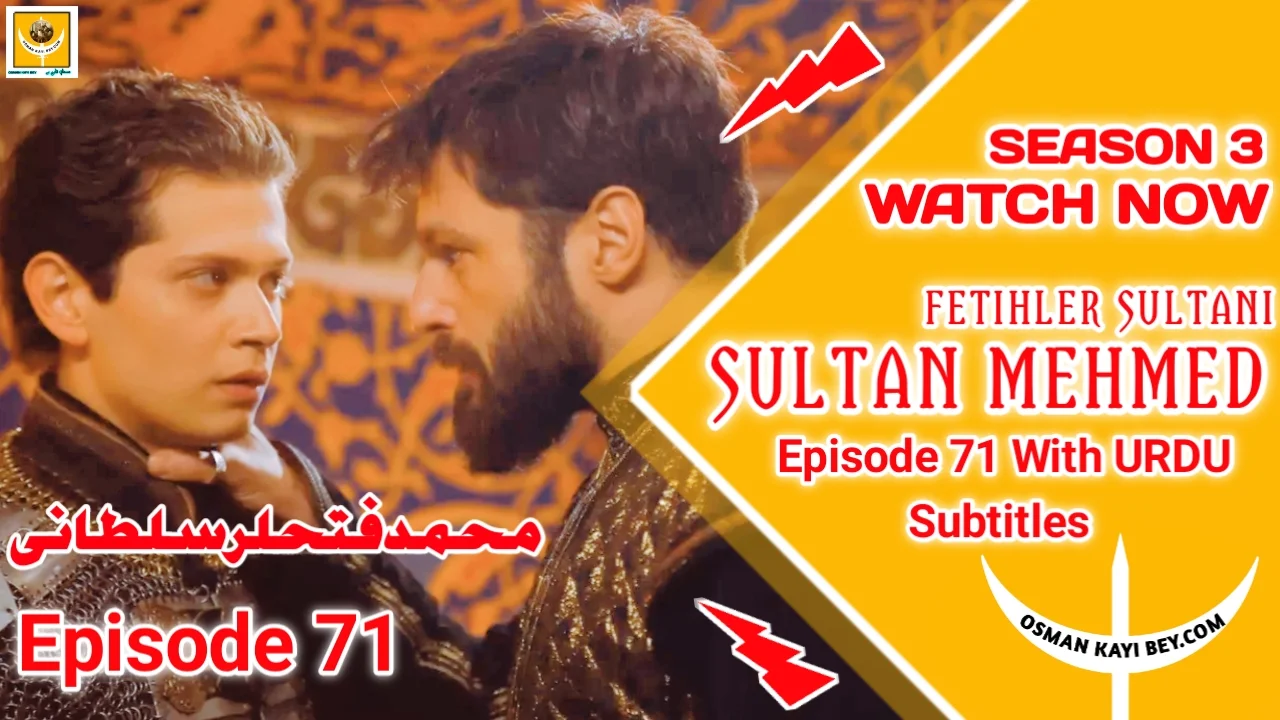
Mehmed Fetihler Sultani Season 3 Episode 71 With Urdu Subtitles
A Turning Point Between Authority and Uncertainty
Mehmed Fetihler Sultani Season 3 Episode 71 With Urdu Subtitles unfolds with a powerful sense of transition. The episode does not rush into loud battles or dramatic confrontations. Instead, it carefully builds a tense atmosphere where political uncertainty grows beneath visible order. Bursa appears stable from the outside, yet inside the council chambers and private quarters, questions about loyalty, authority, and the future direction of the state quietly intensify. This layered storytelling creates depth, allowing viewers to feel that something larger than a single conflict is taking shape.
At this stage of the narrative, the Ottoman structure stands at a fragile crossroads. Expansion has brought prestige, but expansion has also brought complexity. Every newly gained territory demands administration, security, and economic management. Therefore, the focus subtly shifts from pure conquest to sustainability. The episode emphasizes that holding power is more difficult than seizing it. Through long conversations, silent glances, and carefully framed decisions, it becomes clear that Episode 71 is about preserving what has been built while preparing for what lies ahead.
Orhan Bey’s Calculated Restructuring of Power
Orhan Bey begins to demonstrate a deeper layer of leadership in this episode. Rather than pursuing immediate military glory, he concentrates on reinforcing internal order. He reorganizes responsibilities among trusted commanders, reviews supply chains, and questions inconsistencies in regional reporting. This attention to detail signals growth. He understands that a scattered command structure can weaken even the strongest army. Therefore, he chooses discipline over speed.
The episode portrays Orhan not as a warrior charging forward blindly, but as a ruler aware of long-term consequences. He studies the temperament of each bey, measuring their loyalty not through words but through reactions. Subtle hesitation from certain figures does not go unnoticed. Instead of confronting them directly, Orhan allows time to reveal intentions. This patient observation strengthens his authority because it shows confidence. A leader who panics loses control; a leader who waits gains clarity.
Economically, Orhan places greater emphasis on stability. Trade routes near Bursa become central to the discussion. Revenue collection, caravan safety, and merchant confidence are treated as pillars of strength. This shift demonstrates a realistic understanding of statecraft. Swords may win land, but coin sustains governance. By highlighting financial organization, the episode adds authenticity to the political atmosphere and reinforces the idea that empire-building is as much administrative as it is military.
The Quiet Friction Among the Beys
As the central authority strengthens, subtle discomfort grows among some frontier leaders. A few beys feel that increased oversight limits their independence. They are accustomed to acting freely on the frontier, making quick decisions without constant supervision. Now, with tighter coordination from Bursa, their autonomy narrows. This silent friction does not erupt into open rebellion, yet it lingers like a shadow across meetings.
The storytelling carefully presents this tension through tone rather than confrontation. Brief pauses during discussions, exchanged looks, and guarded responses reveal uncertainty. Orhan senses this hesitation. Instead of reacting harshly, he reinforces unity through shared vision. He reminds them that fragmentation invites external aggression. In doing so, the episode explores a central theme: unity requires the sacrifice of personal pride. Without collective discipline, external enemies will exploit internal cracks.
This internal dynamic adds realism to the political narrative. Empires rarely collapse due to a single invasion; they weaken gradually as trust erodes. Episode 71 subtly plants seeds of potential future challenges, suggesting that leadership must constantly adapt to preserve harmony.
Nilüfer Hatun’s Growing Influence and Emotional Strength
Nilüfer’s character undergoes a quiet transformation in this episode. Rather than being defined by vulnerability, she begins influencing strategic discussions through insight and emotional intelligence. Her understanding of diplomatic behavior, particularly in relation to Byzantine customs, offers a valuable perspective. She does not speak loudly, yet when she does, her words carry weight.
Her resilience symbolizes more than personal survival. It represents continuity and stability within the palace. While warriors face enemies on the battlefield, figures like Nilüfer maintain emotional balance within the ruling household. This balance prevents chaos during uncertain times. Through her calm presence, the episode highlights the often-overlooked strength of women in shaping political endurance.
Furthermore, her interactions reveal a deeper philosophical theme: endurance is a form of power. She does not seek dominance, yet her composure influences outcomes. In a world defined by force, her quiet strength introduces contrast and complexity.
Alaeddin’s Intellectual Preparation for the Future
Alaeddin’s storyline focuses on preparation rather than confrontation. He immerses himself in study, examining military treatises, administrative models, and correspondence records. His curiosity reflects generational evolution. While previous leaders relied heavily on instinct and battlefield courage, Alaeddin embraces structured knowledge as a tool for governance.
This intellectual focus does not diminish his bravery. Instead, it enhances his potential. He understands that modern warfare and administration require planning beyond immediate reaction. Through his dedication to learning, the episode signals a gradual transformation in leadership philosophy. Knowledge becomes a weapon as sharp as any blade.
His internal struggle between proving himself through action and proving himself through strategy adds emotional depth. He seeks recognition, yet he also recognizes that patience shapes greatness. This inner tension humanizes him and strengthens narrative complexity.
Ceremony as Strategy in Bursa
The preparations for a grand ceremony in Bursa unfold with elegance, yet beneath the surface, politics quietly operate. Invitations reflect alliances. Public gestures symbolize loyalty. Every detail becomes a statement of hierarchy and influence. The event serves as more than a celebration; it becomes a demonstration of unity.
However, unity displayed publicly does not erase private uncertainty. Conversations during the gathering reveal cautious optimism mixed with concealed calculation. The episode skillfully uses this setting to explore how diplomacy often hides behind ritual. In times of transition, symbolic acts matter as much as military victories.
I dedicate my time and effort to sharing Islamic history and the legacy of our heroes with the world. Your small donation helps me continue this mission. May Allah reward your support. 🤲
💖 Don’t be shy, even $3 makes a difference and helps keep this work going! ❤️
If You Want Any Specific Episode Message Me on WhatsApp
Join Our Official WhatsApp & Telegram Channel
Mehmed Fetihler Sultani Season 3 Episode 71 With Urdu Subtitles
SOURCE 1
This blend of culture and strategy enriches the storytelling. It reminds viewers that governance is not only about command but also perception. A ruler must appear strong, organized, and supported. Public ceremonies reinforce that image.
SOURCE 2
The Guiding Philosophy of Long-Term Vision
Above all, Episode 71 emphasizes foresight. Leadership is portrayed as a responsibility extending beyond immediate triumph. Orhan’s measured decisions, Nilüfer’s composure, Alaeddin’s preparation, and the careful management of internal dynamics all align with a long-term vision. Expansion remains a goal, yet consolidation takes priority.
SOURCE 3
The message becomes increasingly clear: rapid growth without structure leads to vulnerability. Stability demands patience. Discipline must accompany ambition. Through steady pacing and layered dialogue, the episode crafts a mature political narrative that values wisdom over spectacle.
Conclusion
Mehmed Fetihler Sultani Season 3 Episode 71 With Urdu Subtitles presents a thoughtful and strategically rich chapter in the series. Rather than relying solely on dramatic conflict, it explores the complexities of leadership during transition. Orhan Bey strengthens internal order while managing subtle dissent. Nilüfer demonstrates resilience that supports dynastic continuity. Alaeddin prepares intellectually for future responsibility. Meanwhile, ceremonies and economic planning quietly shape the empire’s direction.
The episode ultimately conveys a timeless principle: true strength lies not only in conquering new lands but in sustaining unity, discipline, and vision within existing borders. Through its flowing narrative and deep character exploration, Episode 71 stands as a reflection on how empires prepare for greatness long before history records their victories.