
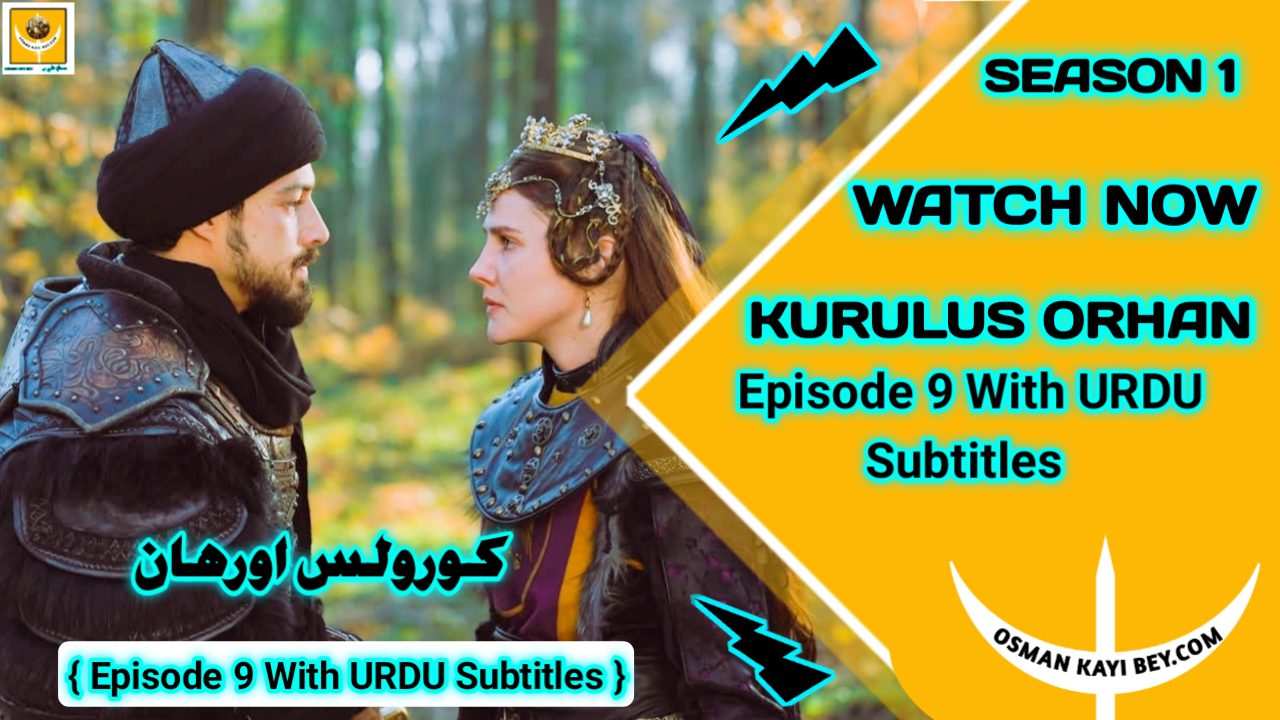
Kurulus Orhan Season 1 Episode 9 With Urdu Subtitles
A Frontier Where Silence Becomes More Dangerous Than War
After Episode 8, the frontier does not explode into chaos. Instead, it freezes. That pause is not accidental. It signals a shift from visible conflict to hidden calculation. Episode 9 exists in this silence, where every decision carries long-term consequences rather than immediate results.
The presence of Princess Asporca inside the Kayi oba, the Temple Knights tightening their unseen grip around Sogut, and the sudden exposure of fragile loyalties force Orhan Bey into a different kind of leadership. This episode is not about survival anymore. It is about direction.
Orhan Bey understands that wars can be won with strength, but states are built only through restraint.
Orhan Bey’s Strategic Evolution: Leadership Without Noise
One of the most important developments moving into Episode 9 is Orhan Bey’s emotional discipline. Episode 8 places him under extreme pressure—surrounded by a Byzantine force, threatened by imperial authority, and destabilized by internal betrayals. Yet Orhan refuses to act impulsively.
This restraint is not hesitation. It is design.
Orhan’s core strategy in Episode 9 revolves around time management. Every passing day that Asporca remains unharmed in the oba weakens Byzantium’s justification for retaliation. Every moment Hector avoids open confrontation exposes his dependence on secrecy. Orhan allows these contradictions to mature instead of forcing a premature conclusion.
Rather than confronting Asporca as an enemy, Orhan positions himself as the only figure capable of maintaining balance. He neither humiliates her nor submits to her threats. This deliberate neutrality disarms her more effectively than aggression ever could.
Behind the scenes, Orhan begins consolidating trust within his inner circle. He limits the flow of information, creating controlled layers of knowledge. This ensures that betrayal, if it occurs again, will expose itself quickly.
In Episode 9, Orhan stops fighting individuals. He starts shaping systems.
Princess Asporca: Authority Without Roots
Asporca’s arrival initially appears dominant, yet Episode 9 quietly dismantles that dominance. She commands soldiers, carries imperial lineage, and speaks with certainty—but none of these grant her legitimacy on the frontier.
A crucial angle often missed is that Asporca’s authority exists only through projection. She does not control land, loyalty, or local alliances. The oba does not fear her, and fear is the currency she relies on most.
Her interactions with Nilufer Hatun become especially revealing. Nilufer does not challenge Asporca openly, yet her composure demonstrates an alternative form of power—one built on respect rather than threat. This contrast unsettles Asporca more than hostility ever could.
As Episode 9 progresses, Asporca begins to sense that she is isolated. Byzantium is distant. Hector is unreliable. The oba is calm. This realization creates internal conflict. She still believes in imperial supremacy, but belief alone no longer feels sufficient.
Asporca’s journey in this episode is not transformation, but disillusionment—the first crack in inherited power.
The Temple Knights: When Secrecy Turns Into Vulnerability
The Temple Knights have always operated beyond banners and borders. Episode 9 reframes them not as unstoppable forces, but as organizations dependent on invisibility.
The discovery of their presence in Sogut is more than a tactical gain. It threatens the very foundation of their authority. Once exposed, their influence loses mystique, and mystique is their greatest weapon.
Hector’s behavior in Episode 9 reflects this fear. Instead of expanding operations, he consolidates. Instead of striking Orhan directly, he begins removing internal risks. This defensive posture reveals an important truth: Hector understands that public awareness would damage him more than military defeat.
Another overlooked angle is that the Temple Knights no longer control the narrative. Orhan does. By choosing when and how to act, Orhan transforms secrecy into liability.
Flavius: The Collapse of Neutral Identity
Flavius enters Episode 9 stripped of ambiguity. His actions in Episode 8 expose him, and exposure eliminates neutrality.
What makes Flavius compelling is not loyalty, but exhaustion. He has survived by shifting allegiances, yet Episode 9 forces him to confront a painful truth: adaptability without identity leads to emptiness.
Orhan does not embrace Flavius, nor does he reject him. Instead, he watches. This silence is intentional. Orhan understands that forced loyalty is fragile, while chosen loyalty carries weight.
Flavius’s internal struggle becomes one of meaning. He must decide whether survival alone is worth the loss of self. This decision will define his future role—not just in Orhan’s story, but in the broader political landscape.
Dafne’s Error: Acting Before Understanding Value
Dafne’s betrayal is often seen as a calculated move, but Episode 9 reframes it as a misunderstanding of power dynamics.
She believes information guarantees protection. In reality, information only delays disposal.
Once Hector receives what he needs, Dafne’s position becomes unstable. Her fear intensifies as she realizes she has traded uncertainty for inevitability. Episode 9 does not rush her downfall; it stretches it, making the consequences heavier.
Her arc reinforces a recurring lesson within the series: survival achieved through betrayal is always temporary.
Sogut Reimagined: More Than a Settlement
In Episode 9, Sogut evolves from a physical location into a symbolic center of authority. Whoever controls Sogut influences trade, communication, and perception.
Orhan’s decision not to militarize Sogut immediately is deliberate. Occupation would suggest insecurity. Stability suggests confidence.
By preserving order, Orhan sends a message not only to enemies, but to civilians and neighboring Beys. Leadership, he implies, is measured by protection, not domination.
This choice further distances Orhan from Hector’s methods, reinforcing the moral contrast between visible authority and hidden control.
Character Analysis: Power Under Pressure
Orhan Bey
Orhan’s defining trait in Episode 9 is patience. He understands that leadership requires absorbing pressure without transmitting panic. His evolution reflects the transition from warrior leadership to statecraft.
Asporca
Asporca symbolizes inherited authority facing lived reality. Her power lacks roots, and Episode 9 forces her to confront that absence.
Hector
Hector represents control through fear and secrecy. His restraint signals vulnerability, not strength.
Flavius
Flavius embodies the cost of prolonged ambiguity. His struggle questions whether redemption is possible without sacrifice.
Themes and Symbolism
Silence as Control
Silence dominates Episode 9. Orhan’s silence stabilizes. Hector’s silence conceals. Asporca’s silence reflects doubt.
Legitimacy Versus Force
True authority emerges through acceptance, not imposition.
Exposure
Those who rely on shadows fear light more than swords.
Historical and Cultural Perspective
The episode reflects real frontier politics where alliances shifted rapidly and authority was negotiated daily. Hostage diplomacy, intelligence networks, and symbolic gestures often outweighed battlefield victories.
I dedicate my time and effort to sharing Islamic history and the legacy of our heroes with the world. Your small donation helps me continue this mission. May Allah reward your support. 🤲
💖 Don’t be shy, even $3 makes a difference and helps keep this work going! ❤️
The Temple Knights echo historical orders that operated independently of monarchs, destabilizing regions while claiming religious legitimacy. Their eventual decline historically followed public exposure—mirrored strongly in this episode.
SOURCE 1
Predictions and Long-Term Implications
Episode 9 sets three major trajectories. Asporca’s gradual detachment from blind imperial loyalty, the weakening of the Temple Knights’ influence, and Orhan’s emergence as a stabilizing authority.
Future conflicts will revolve less around territory and more around legitimacy.
SOURCE 2
I dedicate my time and effort to sharing Islamic history and the legacy of our heroes with the world. Your small donation helps me continue this mission. May Allah reward your support. 🤲
💖 Don’t be shy, even $3 makes a difference and helps keep this work going! ❤️
Key Takeaways
- Orhan Bey weaponizes restraint
- Asporca’s authority begins to erode internally
- The Temple Knights fear visibility
- Flavius reaches the end of neutrality
- Sogut becomes a symbol of rightful rule
Frequently Asked Questions
Is Episode 9 focused on action?
No. It emphasizes psychological and political tension.
Does Orhan Bey trust Flavius?
Observation replaces trust. Loyalty must be chosen.
Will Asporca turn against Byzantium?
Not immediately. Doubt is the first step.
Why is Sogut important?
It represents control over narrative, not just land.
Conclusion
Kurulus Orhan Season 1 Episode 9 With Urdu Subtitles marks a decisive shift in the series. Conflict no longer roars; it watches. Power no longer charges; it waits. Orhan Bey steps into a role defined not by conquest, but by composure—laying the groundwork for a future shaped by legitimacy rather than fear.